Forces applied to the head and their relationship to risk of brain injury


By: Dr. TIMOTHY J.WALILKO, PH.D., Biomedical Engineer
May 7, 2012
Preventing concussion and traumatic brain injury (TBI) has been an ongoing mission for protective equipment developers. Unfortunately, the variety of potential injurious events combined with the individual user vulnerabilities make proper design and use of protective gear a constant challenge. Through understanding of the injuries that occur and the loads that cause those injuries, directed improvements to protective equipment can be made to reduce both the incidence and severity of injuries that occur during sporting events, automobile crashes, and even combat. However, current evaluation and rating standards (e.g., the Head Injury Criterion), are inadequate for the proper evaluation of most protective equipment, particularly oral protective appliances built to reduce loads transmitted through the jaw and mandible and into the skull and brain. . .

PDF Document Link:
By Dr. TIMOTHY J.WALILKO, PH.D., Biomedical Engineer -Observations (20120505)
Or use link just below -
Continue reading

Football findings suggest concussions caused by series of hits.

WEST LAFAYETTE, Ind. – A two-year study of high school football players suggests that concussions are likely caused by many hits over time and not from a single blow to the head, as commonly believed.

Members of the Jefferson High School football team, seen here during a practice last season, were monitored in research to learn how impacts to the head affect brain function. (Purdue University file photo/Andrew Hancock)

Purdue University researchers have studied football players for two seasons at Jefferson High School in Lafayette, Ind., where 21 players completed the study the first season and 24 the second season, including 16 repeating players.
Continue reading

The second quarter of a 1984 Cowboys-Eagles game, the hardest hit he ever took during his Hall of Fame NFL career

The helmet-to-helmet shot knocked Tony Dorsett out cold in the second quarter of a 1984 Cowboys-Eagles game, the hardest hit he ever took during his Hall of Fame NFL career.

“It was like a freight train hitting a Volkswagen”, Dorsett says now.

“Did they know it was a concussion?” he asks rhetorically during an interview with The Associated Press. “They thought I was half-dead.”

Continue reading

NHL concussions put player insurance in question – 60 Players sidelined during 2011-12 Season!

More than 60 players have been sidelined so far in 2011-12 season

CBC Sports Last Updated: Jan 31, 2012 4:54 PM ET

Pittsburgh Penguins centre Sidney Crosby is checked by a trainer during a game against the Washington Capitals on Dec. 1. Crosby remains sidelined with concussion-like symptoms after playing just eight games earlier this season. (Ann Heisenfelt/Reuters)

Related Links: Friedman: Crosby’s recovery plight + 30 Thoughts

Wharnsby: Crosby skates, hockey world awaits update

Concussions and Suspensions List

With dozens of players sidelined with concussions this NHL season — including the game’s biggest star, Pittsburgh Penguin Sidney Crosby — concerns have been raised about the future of insuring players against concussions.

At this point in the 2011-12 season, more than 60 players have suffered a concussion and at least 830 man-games have been lost due to head injuries, according to statistics compiled by CBCSports.ca senior hockey writer Tim Wharnsby.

Continue reading

I just received a penalty for not having a mouth guard. Why do I need to wear one?

The Hockey Doc: The importance of mouth guards By Dr. Rob LaPrade
http://drrobertlaprademd.com

Question: I just received a penalty for not having a mouth guard. Why do I need to wear one?

Answer: I think you know part of the answer to this one already. While the obvious answer to using a mouth guard is that it protects your teeth from being chipped or knocked out, a mouth guard is also a very important safety device to prevent injuries.

The main purpose of a mouth guard is clear. It is there to protect your teeth from possible direct blows where they can either be chipped, significantly fractured, or knocked out. While serving a purpose in this regard, they also help to prevent some of the bad lip and cheek lacerations which can happen when a tooth is broken.

The other purpose of a mouth guard is to act as a shock absorber in your mouth. It serves as a spacer between the top and bottom row of your teeth and absorbs shock should you receive a blow to your head or jaw. You can imagine that if you have a significant blow to your chin that this force is going to go from your chin up through your jaw bone, into your teeth, into your facial bones, etc. In this regard, a mouth guard helps to decrease jaw bone (mandible) fractures.

In addition, it is also believed that the use of a properly-fitted mouth guard helps to decrease the chance of concussions. It does this by helping to absorb the force that your jaw may pick up when there is a significant blow delivered to it. Since a concussion is basically a big bruise to your brain, and could result in permanent brain damage if it occurs on multiple occasions. It is important to try to minimize your exposure to concussions. In this regard, it is highly recommended that you wear a Properly-fitted mouth guard when you play contact ice hockey.  It is also important to not trim down the mouth guard too much or it will be ineffective in acting as a shock absorber.

I hope this answers your question and that you choose to wear a mouth guard in all ice hockey related activities in the future. Wearing a mouth guard, and the rules which enforce it, are sort of like the rules for having seatbelts in cars. The mouth guard serves as a seatbelt to protect your teeth, jaw bone, and brain.

Robert F. LaPrade, M.D., Ph.D. is a complex knee surgeon at The Steadman Clinic in Vail, Colorado.  He is very active in research for the prevention and treatment of ice hockey injuries. Dr. LaPrade is also the Chief Medical Research Officer at the Steadman Philippon Research Institute. Formerly, he was the team physician for the University of Minnesota men’s hockey team and a professor in the Department of Orthopaedic Surgery at the U of M. If you have a question for the Hockey Doc, e-mail it to editor @ letsplayhockey . comThis e-mail address is being protected from spambots. You need JavaScript enabled to view it .

Last Updated on Thursday, 16 February 2012 10:25

Copyright © 2012 Let’s Play Hockey. All Rights Reserved.

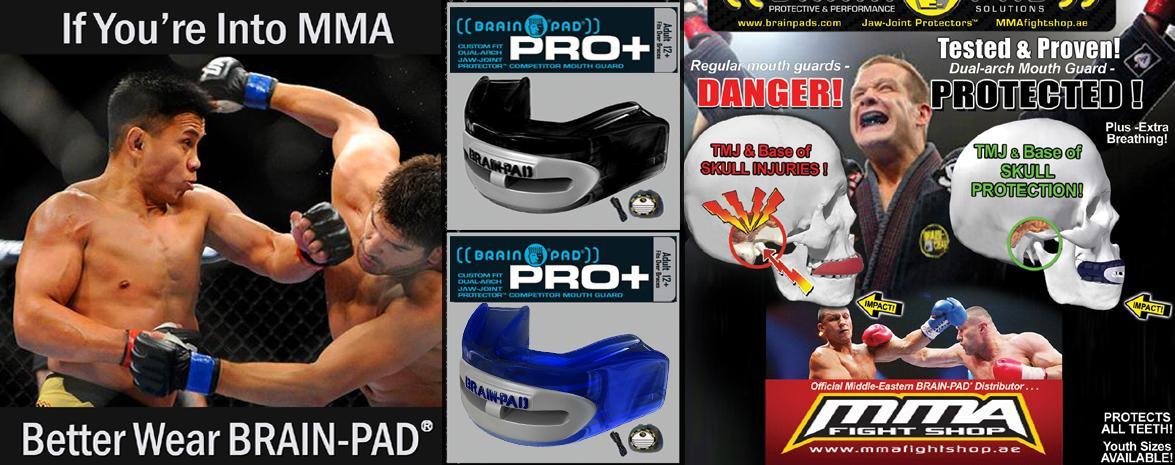
MMA – INTERNAL HEAD PROTECTION

                  Brain-Pad®  Jaw-Joint Protector                         upper mouth guard

The Jaw-Joint complex is the most complex, fragile, and arguably the most over-looked and under-protected joint of the human body.  Jaw-Joint damage is permanent.

The posterior socket walls which align the back of the jaw bones are only 1/6 of an inch thick. Cracks in the posterior socket wall ( ie: green stick fractures ) do not return to their natural shape after trauma such as lower jaw impacts or impactions, instead, they calcify ( harden ) after being elongated back towards the base of skull and brain.

Behind this thin socket wall reside major nerves running from the base of the skull to all parts of the body.  An elongated socket permanently interferes with these vital body-controlling nerves as they attempt to communicate with the brain and affect muscular strength, balance, and coordination.

The Jaw-Joint complexes are crucial to competitive success and also key-players in loss of “The Competitive Edge”.  Unfortunately they are also the least-publicized and least-protected joints of the human anatomy.  When the head is a legitimate target, they must be protected to avoid long-term, permanent damage.

Vicks Lacks Mouth Guard When Injured

Published : Tuesday, 20 Sep 2011, 7:09 PM CDT

(NewsCore) – It is believed football mouth guards can help prevent concussions — and video analysis of the Sunday’s Philadelphia-Atlanta game shows Michael Vick was not wearing one when he collided with teammate Todd Herremans and left the game, FOX Sports reported Tuesday.

Vick suffered a concussion and lacerated tongue from the impact – both of which may not have occurred had he been using that piece of protective equipment.

The Eagles declined comment through a team spokesman and Vicks was not available to comment on whether he was wearing a mouth guard.

NFL players are not required to use mouth guards because of pushback from the NFL Players Association about making them mandatory, despite the league’s strong anti-concussion efforts.

Wonder if a Brain-Pad®  would have made this play a ‘non-issue’  ?

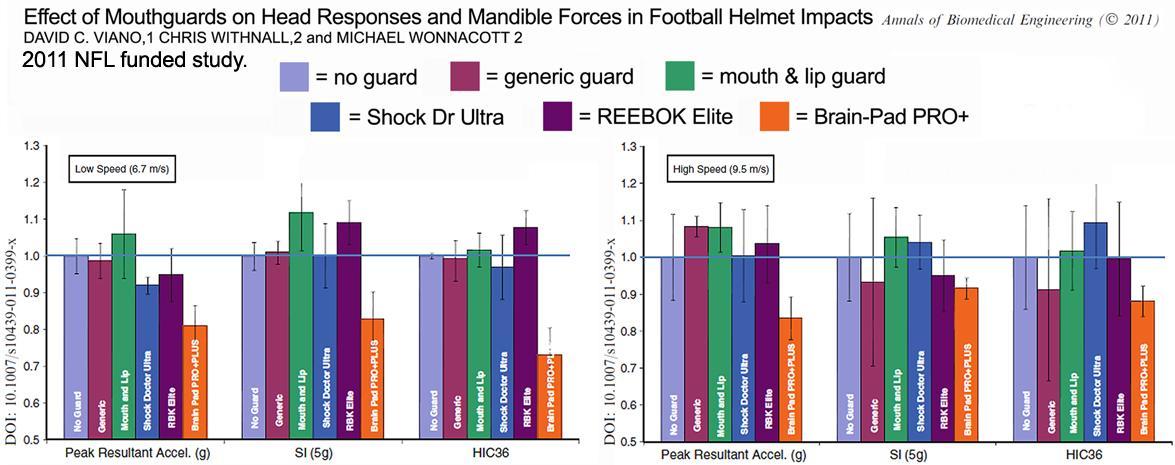
Brain-Pad® Jaw-Joint Protector™ is the only
bio-mechanically tested mouth guard.